

Classification of Administrative Action – Necessity
Introduction Administrative authorities perform various functions to implement laws, maintain public order, protect public interest and provide essential services. These functions are known as Administrative Actions. Administrative Law classifies…
Impact and Implications of the Doctrine of Separation of Powers and Rule of Law on Administrative Law
Introduction Administrative Law regulates the powers, functions and activities of administrative authorities. In a modern welfare state, the government performs several functions relating to public welfare, economic development, social justice and public…
Rule of Law on Administrative law
Introduction The Rule of Law is one of the fundamental principles of modern democratic government. It means that the law is supreme and every person, including government officials and public authorities, is subject to the law. The concept of Rule of Law…
Doctrine of Separation of Powers
Introduction The Doctrine of Separation of Powers is an important principle of constitutional law. It aims to prevent the concentration of governmental powers in a single authority and protect individual liberty. According to this doctrine, the powers of…
Nature and Scope of Administrative Law
Introduction Administrative Law is an important branch of Public Law that deals with the organisation, powers, functions and responsibilities of administrative authorities. In a modern welfare state, the Government performs several functions relating to…
Definition of Administrative Law
Introduction Administrative Law is an important branch of Public Law. It deals with the powers, functions, duties and responsibilities of administrative authorities. It regulates the relationship between the Government and individuals and ensures that…

Explain the federal character of the Indian Constitution.
Introduction Federalism is a system of government in which powers are divided between the Central Government and the State Governments by the Constitution. Each level of government exercises its powers within its constitutionally assigned sphere. The…

What is the Preamble? What are the objectives and values enshrined in the Preamble?
Indian Constitution Introduction The Preamble is the introductory statement of the Constitution of India. It contains the basic philosophy, ideals, objectives and aspirations of the Constitution. It declares the source of constitutional authority and…
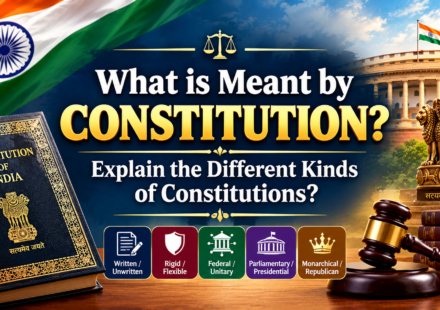
Define Constitution. What are the Different Kinds of Constitutions?
Introduction A Constitution is the fundamental law of a country. It lays down the framework of government, distributes powers among different organs of the State, establishes their functions and limitations, and protects the rights and liberties of the…
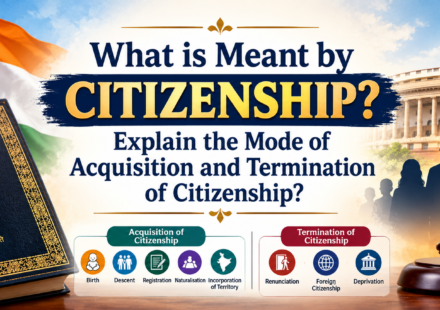
Citizenship: Modes of Acquisition and Termination of Citizenship.
Introduction Citizenship is the legal status of a person as a member of a particular State. It establishes the legal relationship between an individual and the State and gives rise to certain rights, privileges and duties. In India, the provisions…