Emergency Provisions under the Constitution of India
Introduction
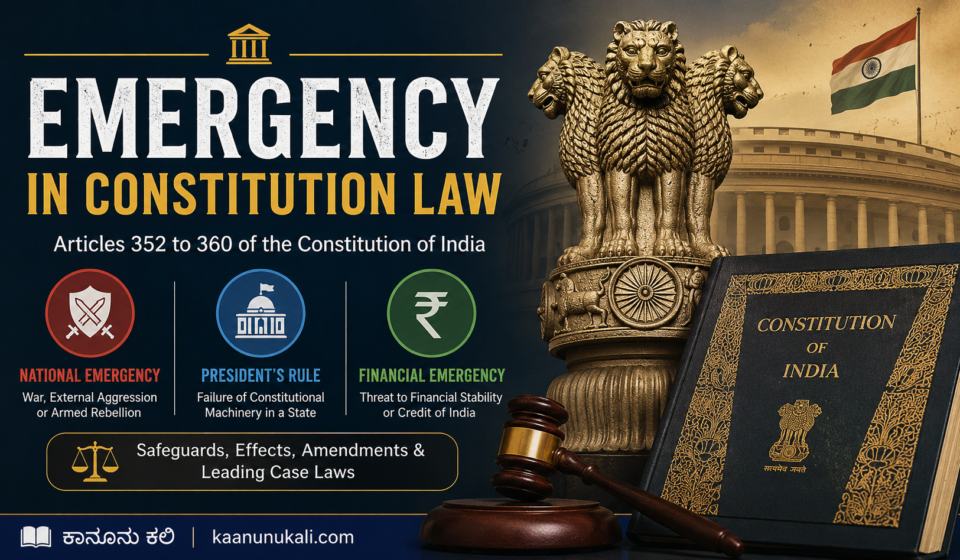
The Constitution of India contains emergency provisions under Part XVIII (Articles 352 to 360). These provisions enable the Central Government to deal with extraordinary situations such as war, external aggression, armed rebellion, failure of constitutional machinery in a State, or financial instability. During an emergency, the Union Government acquires wider powers to protect the sovereignty, unity, integrity, and security of the nation.
Meaning of Emergency
An emergency is an exceptional situation in which the normal distribution of powers between the Union and the States is temporarily altered to ensure effective governance and national security.
Types of Emergencies
The Constitution provides three types of emergencies:
1. National Emergency (Article 352)
A National Emergency may be proclaimed by the President if satisfied that the security of India or any part thereof is threatened by:
- War
- External Aggression
- Armed Rebellion
(Before the 44th Constitutional Amendment, the term “Internal Disturbance” was used instead of “Armed Rebellion.”)
Conditions
- Written recommendation of the Union Cabinet is mandatory.
- The President issues the proclamation.
- Must be approved by both Houses of Parliament within one month.
- Approval requires a special majority.
- Valid for six months and can be extended every six months with parliamentary approval.
Effects
- The Union Government gets wider legislative and executive powers.
- Parliament can legislate on State List subjects.
- Fundamental Rights under Article 19 are automatically suspended only in case of war or external aggression (Article 358).
- Other Fundamental Rights may be suspended under Article 359, except Articles 20 and 21.
- Centre gains greater control over States.
2. State Emergency / President’s Rule (Article 356)
President’s Rule is imposed when the constitutional machinery in a State fails.
Grounds
- Report of the Governor.
- Or otherwise, if the President is satisfied that the State Government cannot function according to the Constitution.
Approval
- Must be approved by Parliament within two months.
- Initially valid for six months.
- Can be extended every six months.
- Maximum period: Three years, subject to constitutional conditions.
Effects
- State Council of Ministers is dismissed.
- Governor administers the State on behalf of the President.
- State Legislative Assembly may be dissolved or suspended.
- Parliament exercises legislative powers of the State.
Judicial Review
The proclamation is subject to judicial review.
Important Case:
- S. R. Bommai v. Union of India
- The Supreme Court held that the President’s satisfaction is not beyond judicial review.
- Article 356 cannot be misused for political purposes.
3. Financial Emergency (Article 360)
A Financial Emergency may be proclaimed when the financial stability or credit of India or any part of its territory is threatened.
Approval
- Must be approved by Parliament within two months.
- Continues until revoked by the President.
Effects
- Centre may issue financial directions to States.
- Salaries of government employees, including judges of the Supreme Court and High Courts, may be reduced.
- States must reserve Money Bills for the President’s consideration.
Note: No Financial Emergency has been declared in India so far.
44th Constitutional Amendment Act, 1978
The 44th Amendment introduced important safeguards:
- Replaced “Internal Disturbance” with “Armed Rebellion.”
- Made written advice of the Cabinet compulsory.
- Reduced misuse of emergency powers.
- Protected Articles 20 and 21 from suspension.
- Allowed one-tenth of Lok Sabha members to demand a special sitting to revoke the National Emergency.
Comparison of the Three Emergencies
| Feature | National Emergency | President’s Rule | Financial Emergency |
|---|---|---|---|
| Article | 352 | 356 | 360 |
| Ground | War, External Aggression, Armed Rebellion | Failure of Constitutional Machinery | Financial instability |
| Area | Whole or part of India | Particular State | Whole or part of India |
| Approval | Within 1 month | Within 2 months | Within 2 months |
| Maximum Duration | Six months at a time (renewable) | Three years (subject to conditions) | Until revoked |
Important Constitutional Articles
- Article 352 – National Emergency
- Article 353 – Effect of National Emergency
- Article 354 – Distribution of Revenue
- Article 355 – Duty of the Union to protect States
- Article 356 – President’s Rule
- Article 357 – Exercise of legislative powers during President’s Rule
- Article 358 – Suspension of Article 19
- Article 359 – Suspension of enforcement of Fundamental Rights
- Article 360 – Financial Emergency
Landmark Cases
- S. R. Bommai v. Union of India – Limited misuse of Article 356 and established judicial review.
- Minerva Mills Ltd. v. Union of India – Reinforced the Basic Structure Doctrine and emphasized limits on emergency powers.
- ADM Jabalpur v. Shivkant Shukla – Held that habeas corpus could not be enforced during the Emergency; this view was later widely criticized and effectively overturned in later constitutional jurisprudence.
Conclusion
The emergency provisions are designed to protect the nation during exceptional circumstances while maintaining constitutional governance. The experience of the 1975–1977 Emergency led to stronger safeguards through the 44th Constitutional Amendment, ensuring that emergency powers are exercised with greater accountability and subject to parliamentary and judicial oversight. For KSLU examinations, emphasize the three types of emergencies, their constitutional provisions, effects, safeguards, and leading case law.