Origin and Development of Muslim Law
Introduction
Muslim Law, also known as Islamic Law or Shariat, is a system of law based on the principles of Islam. It regulates the religious, social, moral, and legal aspects of the life of Muslims. Muslim Law originated in Arabia during the 7th century A.D. and gradually developed through various sources and interpretations by Islamic jurists.
Meaning of Muslim Law
According to Abdul Rahim, Muslim Law is “the body of rules regulating the life of Muslims and derived from the Quran and the traditions of Prophet Muhammad.”
Origin of Muslim Law
1. Quran
The Quran is the primary and most authoritative source of Muslim Law. It contains the divine revelations made by Allah to Prophet Muhammad through the Angel Gabriel. The Quran lays down rules relating to marriage, divorce, inheritance, contracts, succession, and other legal matters.
2. Sunnat or Hadith
Sunnat refers to the practices, sayings, and approvals of Prophet Muhammad. Hadiths are records of these traditions and serve as an explanation and supplement to the Quran. Where the Quran is silent, the Sunnat provides guidance.
Development of Muslim Law
After the death of Prophet Muhammad in 632 A.D., new legal problems arose. To solve these issues, Islamic jurists developed additional sources of law.
1. Ijma (Consensus)
Ijma means the consensus of learned Muslim jurists on a particular legal issue. When neither the Quran nor the Sunnat provides a direct answer, the unanimous opinion of scholars becomes a source of law.
2. Qiyas (Analogical Deduction)
Qiyas means applying the principles of the Quran and Sunnat to new situations through analogy. It enables Muslim Law to adapt to changing social conditions.
3. Customs (Urf)
Certain customs and usages accepted by society are recognized as sources of Muslim Law provided they are not contrary to the Quran and Sunnat.
4. Judicial Decisions
Decisions of courts have played an important role in interpreting and developing Muslim Law, especially in India.
5. Legislation
Modern statutes enacted by legislatures have considerably modified and developed Muslim Law. Examples include:
- Muslim Personal Law (Shariat) Application Act, 1937
- Dissolution of Muslim Marriages Act, 1939
- Muslim Women (Protection of Rights on Divorce) Act, 1986
Schools of Muslim Law
As Muslim Law developed, different schools of jurisprudence emerged.
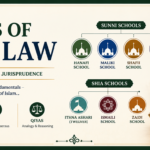
Sunni Schools
- Hanafi School
- Maliki School
- Shafii School
- Hanbali School
Shia Schools
- Ithna Ashari School
- Ismaili School
- Zaidi School
Development of Muslim Law in India
Muslim Law was introduced into India during the Muslim rule. It was administered by Muslim rulers and later recognized by British courts in matters relating to marriage, divorce, inheritance, maintenance, and waqf. Even after independence, Muslim Personal Law continues to govern the personal affairs of Muslims in India.
Conclusion
Muslim Law originated from the Quran and the traditions of Prophet Muhammad and developed through Ijma, Qiyas, customs, judicial decisions, and legislation. It is one of the oldest legal systems in the world and continues to play an important role in regulating the personal laws of Muslims.