
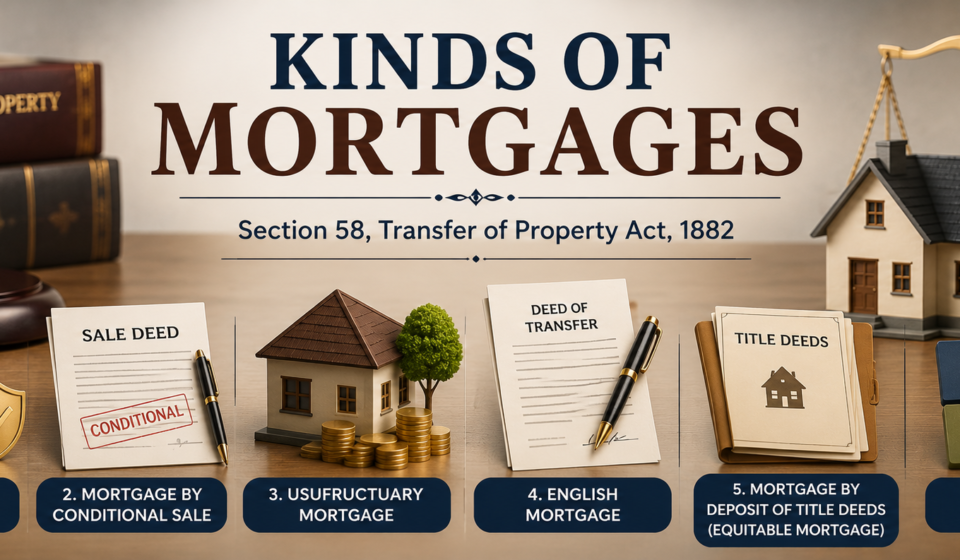
Kinds of Mortgages – Section 58 of the Transfer of Property Act, 1882
Kinds of Mortgages
Section 58 of the Transfer of Property Act, 1882
Introduction
A Mortgage is one of the most important modes of transfer of an interest in immovable property. It is governed by Section 58 of the Transfer of Property Act, 1882. In modern banking and finance, mortgages play a vital role by enabling individuals and businesses to obtain loans against immovable property.
Section 58 not only defines a mortgage but also classifies it into six different kinds, each having distinct legal characteristics and consequences.
This topic is frequently asked in KSLU LLB examinations for 10, 16, and 20 marks.
Meaning of Mortgage
According to Section 58(a):
“Mortgage is the transfer of an interest in specific immovable property for the purpose of securing the payment of money advanced or to be advanced by way of loan, an existing or future debt, or the performance of an engagement which may give rise to a pecuniary liability.”
Kinds of Mortgages
Section 58 classifies mortgages into the following six kinds:
- Simple Mortgage
- Mortgage by Conditional Sale
- Usufructuary Mortgage
- English Mortgage
- Mortgage by Deposit of Title Deeds (Equitable Mortgage)
- Anomalous Mortgage
1. Simple Mortgage
Section 58(b)
Definition
In a Simple Mortgage, the mortgagor does not deliver possession of the property to the mortgagee. Instead, the mortgagor personally undertakes to repay the mortgage money and agrees that, in case of default, the mortgagee has the right to cause the mortgaged property to be sold through the court.
Essential Features
- No transfer of possession.
- Personal liability of the mortgagor.
- Mortgagee can enforce the mortgage only through the court.
- Sale proceeds are applied towards repayment of the debt.
Illustration
A mortgages his house to a bank for ₹20 lakh. He continues to live in the house. If A fails to repay the loan, the bank can approach the court for the sale of the property.
2. Mortgage by Conditional Sale
Section 58(c)
Definition
In this mortgage, the mortgagor ostensibly sells the property to the mortgagee subject to certain conditions:
- If the mortgage money is repaid, the sale becomes void.
- If the money is not repaid, the sale becomes absolute.
- On repayment, the buyer must re-transfer the property.
Essential Features
- Appears as a sale but is actually a mortgage.
- Ownership depends upon fulfillment of conditions.
- Usually embodied in a single document.
Illustration
A executes a document stating that if he repays ₹10 lakh within three years, the property will be returned; otherwise, the sale becomes absolute.
Landmark Case
Pandit Chunchun Jha v. Sheikh Ebadat Ali (1954)
Principle: The Supreme Court held that the intention of the parties and the language of the document determine whether the transaction is a mortgage by conditional sale or an outright sale.
3. Usufructuary Mortgage
Section 58(d)
Definition
The mortgagor delivers possession of the property to the mortgagee. The mortgagee enjoys the rents and profits from the property in lieu of interest or towards repayment of the principal amount.
Essential Features
- Possession is transferred.
- No personal liability of the mortgagor.
- Mortgagee enjoys income from the property.
- Mortgagee generally cannot sue for sale or foreclosure.
Illustration
A mortgages his agricultural land to B. B cultivates the land and appropriates the income towards the mortgage amount.
4. English Mortgage
Section 58(e)
Definition
The mortgagor transfers the property absolutely to the mortgagee, subject to the condition that the mortgagee will re-transfer the property upon repayment of the mortgage money on a specified date.
Essential Features
- Absolute transfer of ownership.
- Personal covenant to repay.
- Re-transfer after repayment.
- Commonly used by banks and financial institutions.
Illustration
A transfers ownership of his property to a bank and agrees to repay the loan within five years. After repayment, the bank must transfer the property back.
5. Mortgage by Deposit of Title Deeds (Equitable Mortgage)
Section 58(f)
Definition
A mortgage is created by depositing the title deeds of immovable property with the mortgagee with the intention of creating security for the debt.
Essential Features
- No formal mortgage deed is essential.
- Possession of property remains with the mortgagor.
- Security is created through deposit of original title deeds.
- Widely used in banking practice.
Illustration
A deposits the original sale deed of his house with a bank to secure a housing loan.
Landmark Case
United Bank of India v. Lekharam Sonaram & Co. (1965)
Principle: Mere deposit of title deeds with an intention to create security constitutes a valid mortgage under Section 58(f).
6. Anomalous Mortgage
Section 58(g)
Definition
An Anomalous Mortgage is any mortgage that does not fall within the previous five categories. It combines features of two or more kinds of mortgages.
Essential Features
- Hybrid mortgage.
- Rights and liabilities depend upon the contract.
- Common in local customs and commercial transactions.
Illustration
A mortgage combines features of both a usufructuary mortgage and a simple mortgage.
Comparison of Different Kinds of Mortgages
| Type | Possession | Personal Liability | Court Sale | Ownership |
|---|---|---|---|---|
| Simple Mortgage | No | Yes | Yes | No |
| Mortgage by Conditional Sale | Usually No | No | Foreclosure | Conditional |
| Usufructuary Mortgage | Yes | No | No | No |
| English Mortgage | Usually No | Yes | Yes | Absolute (subject to reconveyance) |
| Deposit of Title Deeds | No | Yes | Yes | No |
| Anomalous Mortgage | Depends on contract | Depends | Depends | Depends |
Right of Redemption
The mortgagor has the Right of Redemption under Section 60 of the Transfer of Property Act, 1882. After repayment of the mortgage money, the mortgagor is entitled to recover the property and all title documents from the mortgagee.
Landmark Case
Narandas Karsondas v. S.A. Kamtam (1977)
Principle: The Supreme Court held that the right of redemption is a valuable statutory right and continues until it is legally extinguished.
Important Case Laws
1. Pandit Chunchun Jha v. Sheikh Ebadat Ali (1954)
- Mortgage by conditional sale depends upon the intention of the parties.
2. Narandas Karsondas v. S.A. Kamtam (1977)
- Right of redemption is a statutory right.
3. United Bank of India v. Lekharam Sonaram & Co. (1965)
- Deposit of title deeds creates a valid equitable mortgage.
4. K.J. Nathan v. S.V. Maruthi Rao (1965)
- Delivery of title deeds with the intention to create security is sufficient to constitute a mortgage by deposit of title deeds.
Conclusion
The Transfer of Property Act, 1882 classifies mortgages into six distinct types under Section 58, each designed to meet different commercial and legal needs. Understanding the characteristics of each kind of mortgage is essential for law students, legal practitioners, bankers, and property owners. Since this topic is regularly asked in KSLU examinations, students should learn the definitions, distinguishing features, illustrations, and leading case laws to write comprehensive answers.
Frequently Asked Questions (FAQs)
1. Which section defines Mortgage?
Section 58(a) of the Transfer of Property Act, 1882.
2. How many kinds of mortgages are recognized under the Act?
There are six kinds of mortgages under Section 58.
3. Which mortgage is commonly used by banks?
Mortgage by Deposit of Title Deeds (Section 58(f)), also known as an Equitable Mortgage.
4. Which section provides the Right of Redemption?
Section 60 of the Transfer of Property Act, 1882.
5. Which case distinguishes a mortgage by conditional sale from an absolute sale?
Pandit Chunchun Jha v. Sheikh Ebadat Ali (1954).