
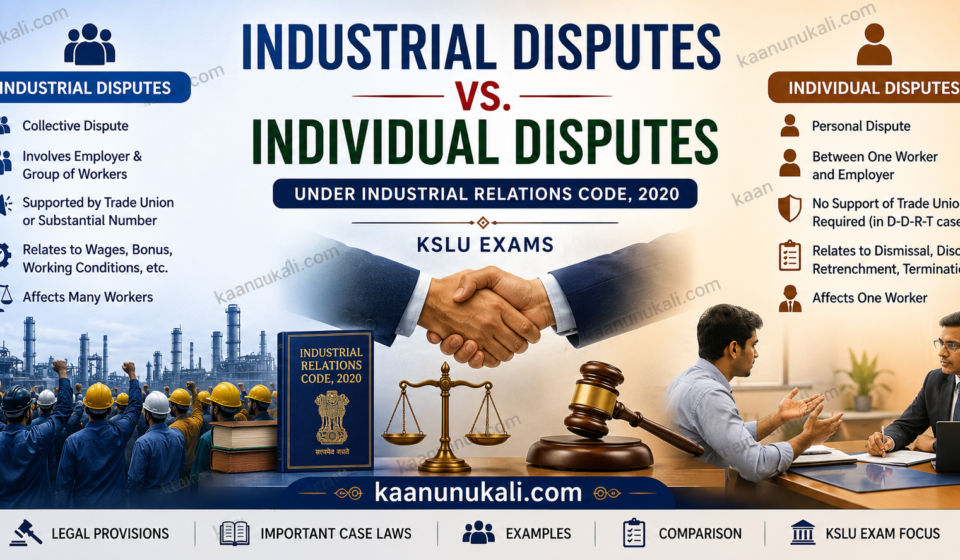
Industrial Disputes vs. Individual Disputes
Industrial Relations Code, 2020
Introduction
The Industrial Relations Code, 2020 aims to maintain industrial peace by providing mechanisms for the prevention and settlement of disputes between employers and workers. Disputes may be collective (Industrial Disputes) or personal (Individual Disputes).
Earlier, an individual dispute was not considered an industrial dispute unless it was supported by a trade union or a substantial number of workmen. However, the law now permits an individual worker to directly raise disputes relating to dismissal, discharge, retrenchment or termination.
Industrial Dispute
Definition
An Industrial Dispute means any dispute or difference between—
- Employer and Employer,
- Employer and Workers, or
- Workers and Workers,
which is connected with:
- Employment,
- Non-employment,
- Terms of employment, or
- Conditions of labour.
Example
Suppose all workers of an automobile factory demand a 20% salary increase and the management refuses. The workers’ union raises the issue before the labour authorities.
This is an Industrial Dispute because it affects all workers collectively.
Individual Dispute
Definition
An Individual Dispute is a dispute between a single worker and the employer concerning his personal service conditions.
Common examples include:
- Illegal dismissal
- Discharge
- Retrenchment
- Termination
- Suspension
- Denial of promotion
- Wrongful transfer
Under the Industrial Relations Code, disputes relating to dismissal, discharge, retrenchment or termination can be raised directly by the affected worker without requiring support from a trade union.
Example
A software company dismisses one employee without conducting a domestic enquiry.
That employee can independently approach the competent authority.
This is an Individual Dispute.
Difference Between Industrial Dispute and Individual Dispute
| Basis | Industrial Dispute | Individual Dispute |
|---|---|---|
| Meaning | Collective dispute | Personal dispute |
| Parties | Employer and group of workers | Employer and one worker |
| Number of workers | Many | One |
| Nature | Collective rights | Individual rights |
| Support of Trade Union | Usually required | Not required in dismissal, discharge, retrenchment or termination cases |
| Scope | Wider | Limited |
| Objective | Protect collective interests | Protect personal employment rights |
| Examples | Wage revision, bonus, strike | Illegal dismissal, wrongful termination |
Important Case Laws
1. Bangalore Water Supply and Sewerage Board v. A. Rajappa (1978)
Principle
The Supreme Court adopted a broad interpretation of “industry” and emphasised the objective of labour welfare. Although this case primarily deals with the meaning of “industry”, it significantly influenced industrial dispute jurisprudence.
Importance
Frequently cited in labour law examinations.
2. Bombay Union of Journalists v. The Hindu (1961)
Principle
An individual dispute does not become an industrial dispute merely because one worker is aggrieved.
It becomes an industrial dispute only when it is supported by a substantial number of workmen or a recognised trade union (subject to statutory exceptions now recognised under the law).
Importance
Explains the traditional distinction between industrial and individual disputes.
3. Workmen of Dimakuchi Tea Estate v. Management of Dimakuchi Tea Estate (1958)
Principle
The Supreme Court explained who can raise an industrial dispute and held that the dispute must have a real connection with employment or conditions of labour.
Importance
Leading authority on the scope of industrial disputes.
4. Newspapers Ltd. v. State Industrial Tribunal (1957)
Principle
An individual grievance becomes an industrial dispute when it is espoused by the trade union or by a substantial body of workmen.
Importance
Clarifies the doctrine of collective espousal.
Practical Examples
Example 1 – Industrial Dispute
Employees of an electricity company demand:
- Increase in wages
- Better safety equipment
- Higher bonus
The trade union represents all workers before the labour authorities.
Result: Industrial Dispute.
Example 2 – Individual Dispute
A bank dismisses one cashier alleging misconduct without following disciplinary procedure.
The cashier alone challenges the dismissal.
Result: Individual Dispute.
Example 3 – Collective Support
A factory dismisses one worker.
Initially, it is an individual dispute.
Later, the workers’ union supports the dismissed worker and raises the matter collectively.
The dispute acquires the character of an industrial dispute (subject to the statutory framework).
Importance of the Distinction
The distinction helps in:
- Determining the appropriate dispute resolution mechanism.
- Protecting collective bargaining.
- Safeguarding individual workers’ rights.
- Preventing industrial unrest.
- Maintaining industrial harmony.
Conclusion
Industrial disputes concern the collective interests of workers and employers, whereas individual disputes relate to the grievance of a single worker. The Industrial Relations Code, 2020 has strengthened the rights of individual workers by allowing them to directly challenge dismissal, discharge, retrenchment or termination without requiring collective support. This reform ensures quicker access to justice while preserving the principles of collective bargaining.
Memory Trick: “D-D-R-T” → Dismissal, Discharge, Retrenchment, Termination. These are the key categories of individual disputes that can be raised directly by the affected worker under the Industrial Relations Code, 2020.