Salient Features of the Indian Constitution
Introduction
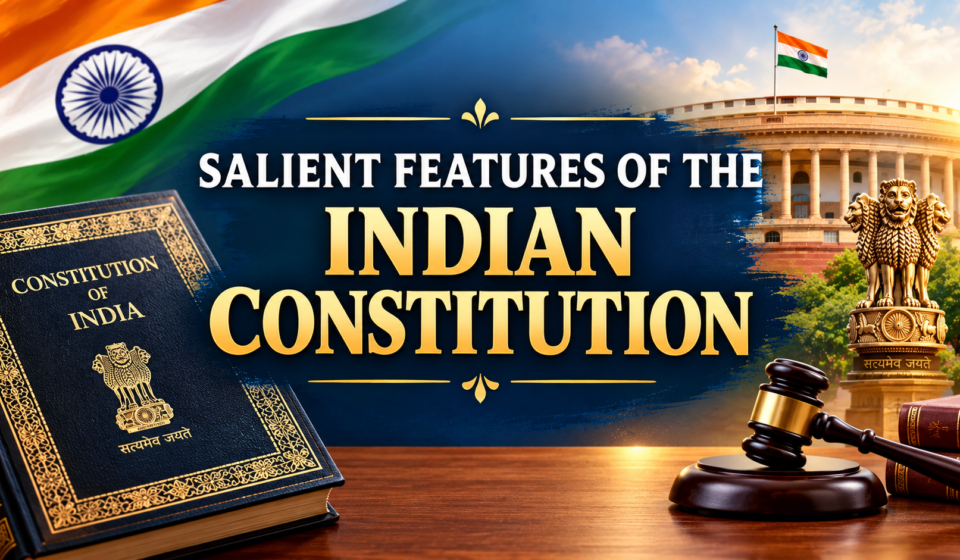
The Constitution of India is the supreme law of the country. It lays down the framework of the government, defines the powers of the legislature, executive and judiciary, and guarantees fundamental rights to citizens.
The Constitution was adopted by the Constituent Assembly on 26th November 1949 and came into force on 26th January 1950. Dr. B. R. Ambedkar was the Chairman of the Drafting Committee.
The Indian Constitution is one of the lengthiest written constitutions in the world. It combines features of several constitutions while reflecting India’s social, political and economic conditions.
Salient Features of the Indian Constitution
1. Lengthiest Written Constitution
The Indian Constitution is one of the lengthiest written national constitutions in the world. It contains detailed provisions relating to the Union and State governments, fundamental rights, Directive Principles of State Policy, the judiciary, elections and emergency powers.
Its length is due to India’s large population, diversity and complex administrative structure.
2. Preamble of the Constitution
The Preamble states the objectives and ideals of the Constitution. It declares India to be a:
- Sovereign
- Socialist
- Secular
- Democratic
- Republic
It aims to secure Justice, Liberty, Equality and Fraternity for all citizens.
The words “Socialist”, “Secular” and “Integrity” were added to the Preamble by the 42nd Constitutional Amendment Act, 1976.
3. Sovereign, Socialist, Secular, Democratic Republic
India possesses the following characteristics:
- Sovereign: India is independent and has authority over its internal and external affairs.
- Socialist: The State aims to reduce economic inequalities and promote social and economic justice.
- Secular: The State has no official religion and treats all religions equally, subject to the Constitution.
- Democratic: The government is elected by the people through periodic elections.
- Republic: The head of the State is elected, directly or indirectly, and is not a hereditary monarch.
4. Parliamentary Form of Government
India follows the parliamentary system of government at the Union and State levels.
The President is the constitutional head of the Union, while the Prime Minister and Council of Ministers exercise executive authority in accordance with the Constitution.
The Council of Ministers is collectively responsible to the Lok Sabha under Article 75(3).
At the State level, the Council of Ministers is collectively responsible to the Legislative Assembly under Article 164(2).
5. Federal System with Unitary Features
The Constitution establishes a federal system in which powers are divided between the Union and the States.
The Seventh Schedule contains three lists:
- Union List: Subjects such as defence, foreign affairs and currency.
- State List: Subjects such as police and public order, subject to constitutional provisions.
- Concurrent List: Subjects such as education, forests and criminal law, on which both Parliament and State Legislatures can legislate, subject to constitutional rules.
However, the Constitution also contains unitary features, including a strong Union Government, single citizenship, emergency provisions and Parliament’s power to reorganise States.
Therefore, India is often described as a federal system with a strong Centre.
6. Fundamental Rights
Fundamental Rights are guaranteed under Part III, Articles 12 to 35 of the Constitution.
They protect individual liberty and prevent arbitrary State action.
The six broad categories of Fundamental Rights are:
- Right to Equality – Articles 14–18
- Right to Freedom – Articles 19–22
- Right against Exploitation – Articles 23–24
- Right to Freedom of Religion – Articles 25–28
- Cultural and Educational Rights – Articles 29–30
- Right to Constitutional Remedies – Article 32
Article 32 enables individuals to approach the Supreme Court for enforcement of Fundamental Rights.
7. Directive Principles of State Policy
The Directive Principles of State Policy are contained in Part IV, Articles 36 to 51.
They guide the State in establishing social and economic justice and promoting public welfare.
Examples include:
- Equal pay for equal work.
- Organisation of village Panchayats.
- Promotion of public health.
- Protection of the environment.
- Provision for free legal aid.
Under Article 37, these principles are not enforceable by courts, but they are fundamental in the governance of the country.
8. Fundamental Duties
Fundamental Duties are contained in Article 51A, Part IVA.
They were added by the 42nd Constitutional Amendment Act, 1976, following the recommendations of the Swaran Singh Committee.
Examples include:
- Respecting the Constitution, the National Flag and the National Anthem.
- Protecting the sovereignty and integrity of India.
- Promoting harmony among citizens.
- Protecting the natural environment.
- Developing scientific temper.
- Safeguarding public property.
There are currently 11 Fundamental Duties.
9. Independent and Integrated Judiciary
India has an independent judiciary to protect the Constitution and uphold the rule of law.
The judicial system consists of:
- Supreme Court of India.
- High Courts.
- Subordinate courts.
The Supreme Court is the highest court of the country. The judiciary has the power of judicial review to examine the constitutional validity of laws and government actions.
Article 141 provides that the law declared by the Supreme Court is binding on all courts within India.
10. Judicial Review
Judicial review is the power of courts to examine whether legislative enactments and executive actions comply with the Constitution.
If a law violates the Constitution, the competent court may declare it unconstitutional.
Articles 13, 32 and 226 are important in this context.
In Kesavananda Bharati v. State of Kerala (1973), the Supreme Court established the Basic Structure Doctrine, holding that Parliament may amend the Constitution under Article 368 but cannot destroy its basic structure.
11. Single Citizenship
India follows the principle of single citizenship.
Unlike certain federal countries, India provides for single Indian citizenship, rather than separate citizenship of the Union and individual States.
This promotes national unity, equality and a common sense of citizenship throughout the country.
12. Universal Adult Suffrage
The Constitution provides for elections based on universal adult suffrage.
Under Article 326, elections to the Lok Sabha and State Legislative Assemblies are based on adult suffrage, subject to constitutional and statutory qualifications.
The voting age was reduced from 21 years to 18 years by the 61st Constitutional Amendment Act, 1988.
This ensures wider democratic participation.
13. Secular State
India is a secular State. The Constitution guarantees freedom of conscience and the right to profess, practise and propagate religion, subject to constitutional limitations.
Articles 25 to 28 deal with freedom of religion.
The State must respect religious freedom and cannot discriminate in a manner prohibited by the Constitution.
14. Emergency Provisions
The Constitution contains emergency provisions under Part XVIII, Articles 352 to 360.
There are three types of emergencies:
- National Emergency – Article 352: May be proclaimed on the grounds of war, external aggression or armed rebellion.
- President’s Rule – Article 356: Applies where a State government cannot be carried on in accordance with the Constitution.
- Financial Emergency – Article 360: May be proclaimed where the financial stability or credit of India or any part of its territory is threatened.
These provisions enable the Union to respond to exceptional constitutional situations.
15. Blend of Rigidity and Flexibility
The Indian Constitution is neither wholly rigid nor wholly flexible.
Some provisions can be amended by a simple majority of Parliament, while others require a special majority under Article 368. Certain amendments also require ratification by at least half of the State Legislatures.
This combination ensures both stability and the ability to adapt to changing circumstances.
16. Local Self-Government
The Constitution recognises rural and urban local self-government.
- Part IX: Panchayats, introduced through the 73rd Constitutional Amendment Act, 1992.
- Part IXA: Municipalities, introduced through the 74th Constitutional Amendment Act, 1992.
These provisions strengthen democratic participation at the grassroots level and promote decentralisation of power.
Important Case Laws
Kesavananda Bharati v. State of Kerala (1973) :
Basic Structure Doctrine
Minerva Mills Ltd. v. Union of India (1980):
Balance between Fundamental Rights and Directive Principles; limits on amending power
S. R. Bommai v. Union of India (1994):
Federalism and secularism as basic features of the Constitution
Golaknath v. State of Punjab (1967):
Historical decision on Parliament’s power to amend Fundamental Rights, later modified by the constitutional framework and subsequent rulings
Conclusion
The Indian Constitution is a unique combination of federalism, parliamentary democracy, Fundamental Rights, Directive Principles, an independent judiciary and emergency provisions. It seeks to maintain a balance between individual liberty and social welfare, as well as between the Union and the States.
Its flexibility allows necessary changes, while the Basic Structure Doctrine protects its essential constitutional identity. Thus, the Indian Constitution serves as the foundation of India’s democratic governance, national unity and rule of law.