
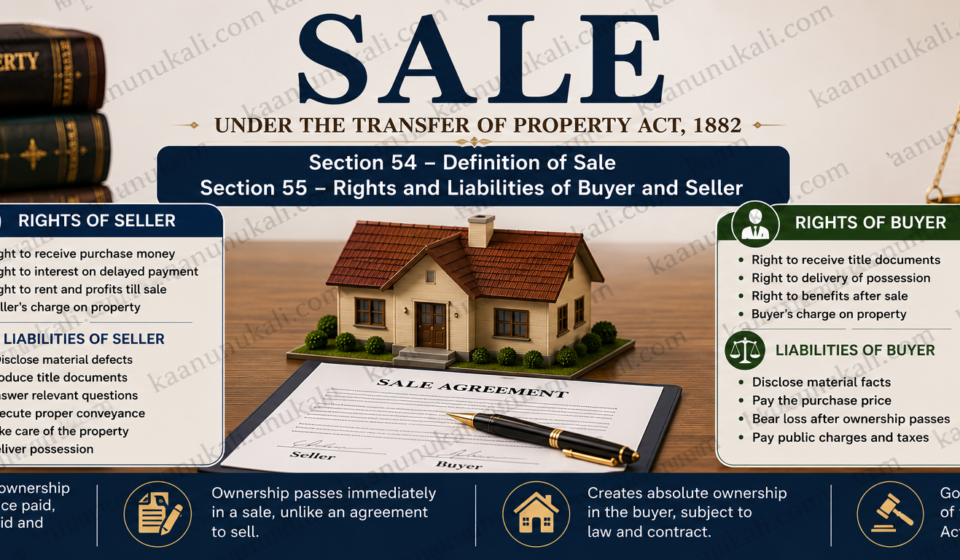
Define Sale.. Rights and Liabilities of Buyer and Seller
Introduction
Sections 54 & 55 of the Transfer of Property Act, 1882
The Transfer of Property Act, 1882 governs the transfer of immovable property in India. Among the various modes of transfer recognized by the Act, Sale is the most common and important method through which ownership of immovable property is transferred from one person to another.
The law relating to sale is primarily contained in Sections 54 to 57 of the Transfer of Property Act, 1882. In particular, Section 54 defines the term “Sale,” while Section 55 lays down the rights and liabilities of the seller and buyer.
This topic is one of the most frequently asked questions in KSLU LLB examinations for 10, 16, and 20 marks.
Definition of Sale
Section 54 – Transfer of Property Act, 1882
According to Section 54:
“Sale is a transfer of ownership in exchange for a price paid or promised or part-paid and part-promised.”
Simple Meaning
A Sale is the legal transfer of ownership of immovable property by the seller to the buyer in return for a monetary consideration called price.
Unlike a mortgage or lease, a sale transfers absolute ownership from the seller to the buyer.
Essential Elements of Sale
A valid sale must satisfy the following conditions:
1. There must be Two Parties
- Seller (Vendor)
- Buyer (Purchaser)
Both parties must be competent to contract.
2. There must be Transfer of Ownership
A sale transfers complete ownership, including all legal rights and interests, from the seller to the buyer.
3. There must be Immovable Property
Section 54 deals only with the sale of immovable property.
Examples:
- House
- Land
- Building
- Apartment
- Commercial property
4. Price Must be Paid or Promised
The consideration must be money.
It may be:
- Fully paid
- Fully promised
- Partly paid and partly promised
If the consideration is another property instead of money, the transaction is an Exchange under Section 118, not a sale.
5. Transfer Must be Voluntary
The transfer should be made freely without coercion, fraud, or undue influence.
6. Registration
Under Section 54, the sale of tangible immovable property valued at ₹100 or more can be made only through a registered instrument.
Registration is compulsory under the Registration Act, 1908.
Difference Between Sale and Agreement to Sell
Section 54 clearly distinguishes these two concepts.
| Sale | Agreement to Sell |
|---|---|
| Ownership immediately passes | Ownership will pass in future |
| Creates rights in the property | Creates only contractual rights |
| Completed transfer | Executory contract |
| Buyer becomes owner | Seller remains owner until sale is completed |
Rights and Liabilities of Seller
Section 55
Rights of Seller
1. Right to Receive Purchase Money
The seller is entitled to receive the agreed sale price.
2. Right to Interest
If the buyer delays payment, the seller may claim interest where legally permissible or agreed.
3. Right to Rent and Profits
Until ownership passes, the seller is entitled to rents and profits from the property unless otherwise agreed.
4. Seller’s Charge
Section 55(4)(b)
If ownership has passed but the purchase price remains unpaid, the seller has a statutory charge over the property for the unpaid purchase money, unless there is a contract to the contrary.
Liabilities (Duties) of Seller
1. Duty to Disclose Material Defects
Section 55(1)(a)
The seller must disclose latent defects in the property or defects in title that are not discoverable by ordinary care.
2. Duty to Produce Title Documents
Section 55(1)(b)
The seller must produce all title documents for inspection by the buyer.
3. Duty to Answer Relevant Questions
Section 55(1)(c)
The seller must answer all relevant questions regarding the property and title truthfully.
4. Duty to Execute Proper Conveyance
Section 55(1)(d)
On payment of the purchase price, the seller must execute a valid conveyance deed.
5. Duty to Take Care of Property
Section 55(1)(e)
Until delivery of possession, the seller must take reasonable care of the property.
6. Duty to Deliver Possession
Section 55(1)(f)
The seller must place the buyer in possession of the property.
Rights of Buyer
1. Right to Receive Title Documents
The buyer is entitled to receive title deeds after completion of the sale.
2. Right to Delivery of Possession
The buyer has the right to obtain possession after payment and execution of the sale deed.
3. Right to Benefits After Sale
After ownership passes, the buyer is entitled to all rents, profits, and benefits arising from the property.
4. Buyer’s Charge
Section 55(6)(b)
If the buyer has paid the purchase money but the seller fails to complete the sale, the buyer has a statutory charge on the property for the amount paid.
Liabilities (Duties) of Buyer
1. Duty to Disclose Material Facts
Section 55(5)(a)
The buyer must disclose facts affecting the seller’s interest if known exclusively to him.
2. Duty to Pay Purchase Price
The buyer must pay the agreed consideration according to the contract.
3. Duty to Bear Loss After Ownership Passes
After ownership transfers, any accidental loss generally falls upon the buyer.
4. Duty to Pay Public Charges
After completion of the sale, the buyer becomes liable to pay taxes, assessments, and public charges relating to the property.
Important Sections Related to Sale
| Section | Subject |
|---|---|
| Section 54 | Definition of Sale |
| Section 55 | Rights and Liabilities of Buyer and Seller |
| Section 56 | Marshalling by Subsequent Purchaser |
| Section 57 | Court’s Power to Grant Relief in Sale of Encumbered Property |
Landmark Case Laws
1. Narandas Karsondas v. S.A. Kamtam (1977)
Principle:
An agreement to sell does not create any interest or charge in immovable property. Ownership passes only through a valid sale in accordance with law.
2. Rambhau Namdeo Gajre v. Narayan Bapuji Dhotra (2004)
Principle:
A contract for sale does not itself create ownership rights; it merely creates a contractual right to obtain another document of sale.
3. Durga Prasad v. Deep Chand (1954)
Principle:
The Supreme Court explained the remedy of specific performance where the seller fails to complete a valid sale.
4. Suraj Lamp & Industries Pvt. Ltd. v. State of Haryana (2012)
Principle:
The Supreme Court held that ownership of immovable property cannot be transferred through General Power of Attorney (GPA), Agreement to Sell, or Will alone. A valid transfer requires a duly executed and registered sale deed where registration is mandatory.
Difference Between Sale, Mortgage and Lease
| Sale | Mortgage | Lease |
|---|---|---|
| Ownership transferred | Interest transferred as security | Right to enjoy transferred |
| Permanent transfer | Security for debt | Temporary transfer |
| Governed by Section 54 | Governed by Section 58 | Governed by Section 105 |
| Buyer becomes owner | Mortgagor remains owner | Lessor remains owner |
Examination Tips for KSLU Students
For a 16-mark answer, follow this order:
- Introduction
- Definition under Section 54
- Essential Elements of Sale
- Rights of Seller
- Liabilities of Seller
- Rights of Buyer
- Liabilities of Buyer
- Important Sections
- Landmark Case Laws
- Conclusion
Including Section numbers, sub-sections of Section 55, and Supreme Court case laws can help secure higher marks.
Conclusion
A Sale is the complete transfer of ownership of immovable property in exchange for a price. While Section 54 defines the concept of sale, Section 55 carefully balances the rights and obligations of both the seller and the buyer to ensure fairness in property transactions. Proper disclosure, payment of consideration, execution of the sale deed, and delivery of possession are essential for a valid sale. A sound understanding of these provisions, supported by leading judicial decisions, is indispensable for law students and legal practitioners.
Frequently Asked Questions (FAQs)
1. Which section defines Sale?
Section 54 of the Transfer of Property Act, 1882.
2. Which section deals with the rights and liabilities of the buyer and seller?
Section 55 of the Transfer of Property Act, 1882.
3. What is the difference between Sale and Agreement to Sell?
A sale immediately transfers ownership, whereas an agreement to sell creates only a contractual right and ownership passes later.
4. Is registration compulsory for a sale of immovable property?
Yes. For tangible immovable property valued at ₹100 or more, a registered instrument is mandatory under Section 54 and the Registration Act, 1908.
5. Which Supreme Court case held that GPA sales do not convey ownership?
Suraj Lamp & Industries Pvt. Ltd. v. State of Haryana (2012).