
Difference Between Culpable Homicide and Murder Under Bharatiya Nyaya Sanhita, 2023
BNS Sections 100 and 101 Explained:
Introduction
The Bharatiya Nyaya Sanhita, 2023 (BNS) has replaced the Indian Penal Code, 1860 (IPC) as India’s primary criminal law. While many provisions remain substantially similar, the BNS reorganizes and renumbers several offences to make the law more systematic and modern.
Among the most important offences under criminal law are culpable homicide and murder. These offences involve the unlawful causing of a person’s death but differ significantly in terms of the offender’s intention, knowledge, and surrounding circumstances.
Understanding the distinction between Section 100 (Culpable Homicide) and Section 101 (Murder) is essential for law students, legal professionals, competitive examination aspirants, and anyone interested in criminal law.
In this article, we explain these sections in simple language along with illustrations, punishments, exceptions, landmark principles, and the differences between them.
What is Culpable Homicide? (Section 100 BNS)
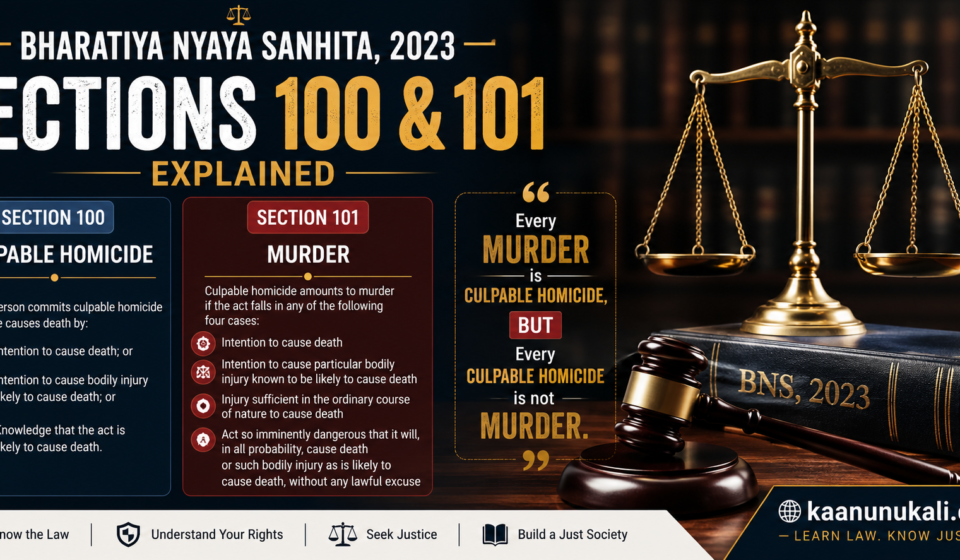
Section 100 of the Bharatiya Nyaya Sanhita defines culpable homicide.
A person commits culpable homicide if he or she causes the death of another person by doing an act:
- With the intention of causing death; or
- With the intention of causing bodily injury that is likely to cause death; or
- With the knowledge that the act is likely to cause death.
The law focuses on the mental element (mens rea) of the accused while committing the act.
Essential Ingredients of Section 100
To establish culpable homicide, the prosecution must prove the following:
1. Death of a Human Being
There must be an actual death.
2. Death Caused by the Accused
The accused’s act must directly or indirectly result in the victim’s death.
3. Intention or Knowledge
The accused must have:
- Intended to cause death; or
- Intended to cause bodily injury likely to cause death; or
- Known that the act was likely to cause death.
Illustrations of Culpable Homicide
Illustration 1
A strikes B on the head with a heavy stick during a quarrel, knowing that such a blow may cause death. B dies.
This amounts to culpable homicide.
Illustration 2
A pushes an elderly person from a staircase, knowing that the fall is likely to cause death.
If the person dies, A commits culpable homicide.
What is Murder? (Section 101 BNS)
Section 101 explains when culpable homicide becomes murder.
Every murder is culpable homicide, but not every culpable homicide is murder.
A culpable homicide amounts to murder if the act falls within any of the following situations.
When Does Culpable Homicide Become Murder?
1. Intention to Cause Death
If the offender intentionally causes another person’s death, it is murder.
Example:
A intentionally shoots B with the objective of killing him.
This is murder.
2. Intention to Cause Particular Bodily Injury
If the offender knows that a particular injury is likely to cause the death of that specific person, it is murder.
Example:
A knows that B suffers from a serious heart condition and deliberately assaults him in a manner likely to cause death.
3. Injury Sufficient to Cause Death
If the injury intentionally caused is sufficient, in the ordinary course of nature, to cause death, it is murder.
Example:
A repeatedly stabs B in the chest with a knife.
Such injuries ordinarily result in death.
4. Imminently Dangerous Act
If a person performs an act that is so dangerous that death is almost certain, without any lawful justification, it amounts to murder.
Example:
Throwing a bomb into a crowded marketplace.
Exceptions Where Murder Becomes Culpable Homicide
Even when the above conditions are satisfied, the offence may not amount to murder if it falls under one of the statutory exceptions.
1. Grave and Sudden Provocation
If the accused loses self-control because of grave and sudden provocation and causes death, the offence may be reduced to culpable homicide.
2. Exceeding Right of Private Defence
If a person exceeds the legal limits of self-defence while acting in good faith, the offence may not amount to murder.
3. Act of Public Servant
A public servant acting in good faith while performing official duties may receive the benefit of this exception if lawful powers are exceeded without malicious intent.
4. Sudden Fight
Where death occurs during a sudden fight without premeditation and without the offender taking undue advantage or acting cruelly, the offence may be culpable homicide instead of murder.
5. Consent
If a person above eighteen years voluntarily consents to the risk leading to death, the case may fall within this exception.
Difference Between Culpable Homicide and Murder
| Culpable Homicide (Section 100) | Murder (Section 101) |
|---|---|
| General offence of causing death | Aggravated form of culpable homicide |
| Intention or knowledge may be less serious | Intention or knowledge is of the highest degree |
| Punishment under Section 105 BNS | Punishment under Section 103 BNS |
| May or may not amount to murder | Always amounts to culpable homicide |
Punishment Under BNS
Punishment for Murder
Section 103 provides punishment for murder.
The offender may be punished with:
- Death penalty; or
- Imprisonment for life; and
- Fine.
Punishment for Culpable Homicide Not Amounting to Murder
Section 105 provides punishment depending upon:
- Whether the act was committed with intention; or
- Merely with knowledge.
The punishment varies according to the circumstances of each case.
Landmark Judicial Principle
One of the most well-known principles in Indian criminal law is:
Every murder is culpable homicide, but every culpable homicide is not murder.
This means:
- Murder is the most serious form of culpable homicide.
- Every murder includes all ingredients of culpable homicide.
- However, many culpable homicides do not satisfy the stricter requirements for murder.
Courts examine:
- Intention
- Knowledge
- Nature of injury
- Weapon used
- Circumstances
- Conduct of the accused
- Medical evidence
before deciding whether the offence is murder or culpable homicide.
Practical Examples
Example 1
A deliberately poisons B’s food intending to kill him.
Offence: Murder.
Example 2
During a heated argument, A pushes B without intending to kill him. B falls, suffers fatal injuries, and dies.
Depending on the facts, this may amount to culpable homicide not amounting to murder.
Example 3
A fires a gun into a crowded bus merely for fun.
Several passengers die.
This is murder because the act is imminently dangerous.
Importance of Sections 100 and 101
These provisions protect society by punishing unlawful killings while also recognizing that not every death is caused with the same degree of criminal intention.
The distinction ensures that punishment remains proportionate to the offender’s mental state and the circumstances of the offence.
Frequently Asked Questions (FAQs)
Is every culpable homicide murder?
No. Every murder is culpable homicide, but every culpable homicide is not murder.
Which section defines murder under BNS?
Section 101 defines when culpable homicide amounts to murder.
Which section defines culpable homicide?
Section 100 of the Bharatiya Nyaya Sanhita, 2023.
What is the punishment for murder?
Under Section 103 BNS, the punishment may be death or imprisonment for life, along with a fine.
What is the main difference between Sections 100 and 101?
Section 100 defines the general offence of culpable homicide, whereas Section 101 specifies the circumstances under which culpable homicide becomes murder.
Conclusion
Sections 100 and 101 of the Bharatiya Nyaya Sanhita, 2023 form the foundation of offences relating to unlawful killing in India. While both provisions deal with causing death, the distinction lies in the degree of intention, knowledge, and surrounding circumstances.
A clear understanding of these provisions is essential for legal practitioners, students, judicial service aspirants, and the general public. Courts carefully evaluate the facts of each case before deciding whether the offence is culpable homicide or murder, ensuring that justice is delivered in accordance with the seriousness of the act.
Disclaimer: This article is intended for educational and informational purposes only. It does not constitute legal advice. For advice on a specific legal matter, consult a qualified legal professional.