Offences Against Children Under Bharatiya Nyaya Sanhita (BNS), 2023
Complete Guide with Sections, Punishments, and FAQs
Offences Against Children Under Bharatiya Nyaya Sanhita (BNS), 2023
Children are among the most vulnerable members of society. Their physical, emotional, and mental well-being requires the highest degree of legal protection. Recognizing this, the Bharatiya Nyaya Sanhita, 2023 (BNS) contains several provisions specifically aimed at protecting children from abandonment, exploitation, trafficking, sexual abuse, and criminal exploitation.
The BNS, which replaced the Indian Penal Code (IPC), retains most child protection offences while reorganizing them under Chapter V – Of Offences Against Woman and Child. These provisions work alongside special laws such as the Protection of Children from Sexual Offences Act, 2012 (POCSO Act), the Juvenile Justice (Care and Protection of Children) Act, 2015, and the Child Labour (Prohibition and Regulation) Act, 1986.
This article explains every offence against children under the BNS in simple language, including punishments, illustrations, legal significance, and frequently asked questions.
Why Special Protection for Children?
Children often lack the maturity to protect themselves from abuse, coercion, or exploitation. They are more likely to become victims of:
- Human trafficking
- Sexual exploitation
- Forced labour
- Kidnapping
- Criminal gangs
- Neglect and abandonment
- Illegal adoption
- Child pornography
- Online grooming
The Constitution of India also guarantees several protections for children under Articles 15(3), 21A, 24, 39(e), and 39(f). The BNS strengthens these constitutional protections by prescribing criminal penalties for offences against children.
Chapter V of BNS – Offences Against Women and Children
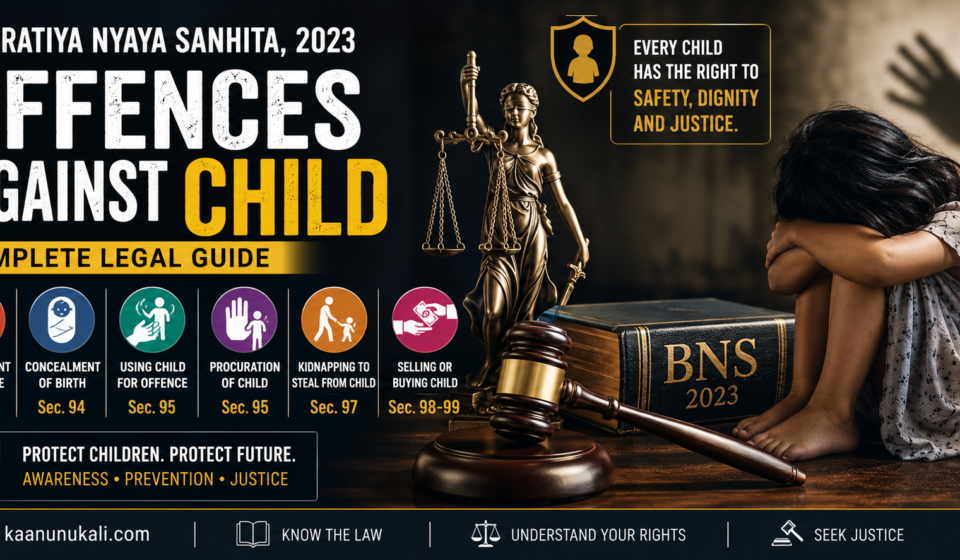
The principal offences against children under the Bharatiya Nyaya Sanhita are covered in Sections 93 to 99.
These provisions criminalize:
- Exposure and abandonment
- Concealment of birth
- Employing children to commit offences
- Procuration for illicit intercourse
- Kidnapping to steal from a child
- Selling children
- Buying children
Section 93 – Exposure and Abandonment of Child Under Twelve Years
Meaning
Section 93 punishes any parent or person legally responsible for the care of a child below twelve years who intentionally abandons or exposes the child in circumstances likely to endanger the child’s life or health.
This offence focuses on the duty of parents and guardians to ensure the child’s safety.
Essential Ingredients
The prosecution must prove:
- The child is below twelve years of age.
- The accused is the parent or legal guardian or has lawful custody.
- The child was intentionally abandoned or exposed.
- The abandonment endangered the child’s life or health.
Punishment
- Imprisonment up to 7 years
- Fine
- Or both
Illustration
A leaves his 8-year-old son alone on a deserted highway during the night with no food or means of protection.
A commits an offence under Section 93.
Section 94 – Concealment of Birth by Secret Disposal of Dead Body
Meaning
Section 94 criminalizes secretly disposing of the dead body of a newborn child to conceal the fact of birth.
The law applies even when it cannot be proved whether the child was born alive.
Essential Ingredients
- A child has recently been born.
- The dead body is secretly disposed of.
- The intention is to conceal the birth.
Punishment
- Imprisonment up to 2 years
- Fine
- Or both
Illustration
A secretly buries the body of her newborn baby to prevent society from learning about the birth.
This amounts to an offence under Section 94.
Section 95 – Hiring, Employing or Engaging a Child to Commit an Offence
Meaning
Children are often manipulated by organized criminal groups because they receive comparatively lenient treatment under juvenile laws.
Section 95 criminalizes using children as instruments for committing crimes.
Acts Covered
- Hiring a child
- Employing a child
- Inducing a child
- Engaging a child for criminal activities
Examples
Using children for:
- Theft
- Drug trafficking
- Pickpocketing
- Begging rackets
- Smuggling
- Cyber fraud
- Robbery
Punishment
The punishment depends upon:
- The offence committed.
- The seriousness of the crime.
- Whether the offence was actually completed.
Courts generally impose stringent punishment considering the exploitation involved.
Section 96 – Procuration of Child
Meaning
Section 96 punishes inducing, persuading, or taking a child from one place to another with the intention that the child may be forced or seduced into illicit sexual intercourse.
This provision seeks to prevent sexual exploitation before the abuse occurs.
Essential Ingredients
The prosecution must establish:
- The victim is a child.
- The accused induced or persuaded the child.
- The intention or knowledge was that the child may be sexually exploited.
Punishment
- Imprisonment up to 10 years
- Fine
Illustration
A trafficker promises employment to a 15-year-old girl and transports her to another city intending to force her into prostitution.
This offence falls under Section 96.
Section 97 – Kidnapping or Abducting Child Under Ten Years to Steal
Meaning
Section 97 protects children below ten years from kidnapping or abduction committed with the intention of stealing ornaments, valuables, or property from them.
Example
A kidnaps a six-year-old child only to remove expensive gold jewellery worn by the child.
This constitutes an offence under Section 97.
Punishment
- Imprisonment up to 7 years
- Fine
Section 98 – Selling Child for Prostitution or Other Unlawful Purposes
Meaning
Section 98 criminalizes selling, transferring, hiring, or disposing of a child for:
- Prostitution
- Sexual exploitation
- Illicit intercourse
- Immoral purposes
- Any unlawful activity
The law presumes unlawful intention where circumstances indicate exploitation.
Punishment
- Rigorous imprisonment from 7 years to 14 years
- Fine
Illustration
Parents sell their minor daughter to a trafficker knowing she will be forced into commercial sexual exploitation.
This offence attracts Section 98.
Section 99 – Buying Child for Prostitution or Other Unlawful Purposes
Section 99 is the counterpart of Section 98.
Instead of punishing the seller, it punishes the buyer.
Any person purchasing, hiring, obtaining possession of, or otherwise acquiring a child for prostitution or sexual exploitation commits this offence.
Punishment
- Rigorous imprisonment from 7 years to 14 years
- Fine
Relationship Between BNS and POCSO Act
Many people assume every offence against children is covered under the BNS.
This is not correct.
The Protection of Children from Sexual Offences (POCSO) Act, 2012 is a special law dealing specifically with sexual offences against children.
Examples include:
- Sexual assault
- Penetrative sexual assault
- Aggravated penetrative sexual assault
- Sexual harassment
- Use of children for pornography
- Storage or dissemination of child sexual abuse material
Whenever applicable, the POCSO Act generally takes precedence as the special legislation, while the BNS may also apply for related offences such as kidnapping, trafficking, or causing hurt.
Importance of These Provisions
The offences under Sections 93 to 99 aim to:
- Protect children from neglect.
- Prevent child trafficking.
- Stop sexual exploitation.
- Prevent organized crime from using children.
- Safeguard children’s dignity and development.
- Strengthen public confidence in the criminal justice system.
Key Differences Between IPC and BNS
Although the offences are substantially similar, the Bharatiya Nyaya Sanhita reorganizes and renumbers them within a modern legislative framework. The underlying objective of protecting children remains unchanged, while terminology and structure have been updated for clarity.
Practical Examples
Example 1
A mother abandons her nine-year-old child at a railway station because she cannot care for him.
Applicable Section: Section 93.
Example 2
A criminal gang recruits children to transport illegal drugs.
Applicable Section: Section 95.
Example 3
A trafficker buys a child for commercial sexual exploitation.
Applicable Section: Section 99.
Example 4
An individual secretly disposes of a newborn’s body to hide the birth.
Applicable Section: Section 94.
Example 5
A person lures a child with false promises of employment to facilitate sexual exploitation.
Applicable Section: Section 96.
Frequently Asked Questions (FAQs)
Which sections of BNS deal with offences against children?
Sections 93 to 99 of the Bharatiya Nyaya Sanhita primarily deal with offences against children.
Does BNS replace the POCSO Act?
No. The POCSO Act continues to operate independently and specifically governs sexual offences against children. The BNS and POCSO Act often apply together depending on the facts of the case.
What is the punishment for selling a child?
Selling a child for prostitution or other unlawful purposes is punishable with rigorous imprisonment ranging from 7 years to 14 years, along with a fine.
Is employing a child to commit theft an offence?
Yes. Engaging or employing a child to commit any offence is punishable under Section 95.
Can parents be punished for abandoning a child?
Yes. A parent or guardian who intentionally abandons or exposes a child below twelve years in a manner that endangers the child’s life or health can be punished under Section 93.
Which law deals with child sexual abuse?
The Protection of Children from Sexual Offences (POCSO) Act, 2012 is the primary legislation dealing with child sexual abuse, though related offences under the BNS may also be invoked.
Conclusion
The Bharatiya Nyaya Sanhita, 2023 reflects India’s continued commitment to safeguarding children from abuse, neglect, exploitation, and trafficking. Sections 93 to 99 provide robust legal mechanisms to punish those who endanger children, while complementary laws such as the POCSO Act and the Juvenile Justice Act strengthen the overall child protection framework.
Parents, guardians, teachers, law enforcement agencies, and society as a whole share the responsibility of ensuring that children grow up in a safe and secure environment. Understanding these legal provisions helps promote awareness, encourages timely reporting of offences, and supports the protection of children’s rights.
Disclaimer
This article is intended for educational and informational purposes only and should not be construed as legal advice. For advice on a specific legal issue, consult a qualified legal professional.